Current News - Telelumen Speaking at AATCC Color Management Workshop
On August 26-27, 2026 the American Association of Textile Chemists and Colorists (AATCC; https://www.aatcc.org) will be presenting the Color Management Workshop (https://www.aatcc.org/aatcc-events/cmw/) in Glendale CA. This workshop, is designed for merchandisers, retailers, manufacturers, product developers, color approval managers, specifiers, and designers. Participants will learn about color principles; how lighting affects color; color palettes and how they affect cost, fashion, durability, and dyeing reproducibility; how to implement a digital color program with suppliers; and much more.
Steve Paolini, President of Telelumen, will be giving a talk on the importance of the light spectrum for light booth viewing sources used in critical color evaluation and the flexibility of the Telelumen programmable spectrum LED light booths.

Current News - Telelumen speaking at IES
During April 29-30th, the IES will be conducting a Virtual Symposium on “Exploring the Lighting Spectrum” - https://ies.org/events/light-for-life/light-for-life-virtual-symposium-exploring-the-lighting-spectrum/. Steve Paolini, President of Telelumen, will give a talk “Revisiting Daylight: Spectral Gaps and Limitations in Electric Lighting" which will be the first presentation on April 29 at 12:05 PM (EST). The presentation will give a deeper understanding of what is missing from indoor electric lighting relative to the variety of natural outdoor sunlight.
The symposium’s purpose is to explore spectral complexity underlying what is commonly referred to as white light. Specifically, how light is measured, described, and interpreted in lighting practice, and how IES standards and methods help bring structure to that understanding. The symposium will discuss specific light spectrum ranges, their distinct properties, design implications, and biological or environmental effects.
Current News - Telelumen Credited in LED Professional Magazine for Full Spectrum Lighting Work
In anticipation of the Light + Building 2026 trade show in Frankfurt Germany, the January/February 2026 issue of LED Professional magazine (by Luger), Klaus Vamberszky, the former CTO of Zumtobel was interviewed on the future of professional lighting. Mr. Vamberszky, expressed his views that in the past decade, LEDs had the biggest impact in lighting, however today there is too much focus on energy efficiency (efficacy) and cost.
Instead, he sees a large part of the future of lighting in developing better light spectra and highlighted the work of Telelumen and president Steve Paolini: “I still see the biggest potential in the light spectra, ranging from UV up to IR radiation; there is a lot of interesting scientific work being done on this right now. In the future we might have an efficient multi-channel multi-color light source without wavelength conversion methods, avoiding the Stokes losses. In terms of technology, Steven Paolini and his Telelumen company have already shown what is possible there….”
When asked where he sees the greatest potential for high-quality and value driven lighting solutions, he identifies healthcare and workplace lighting. The full interview is available here.
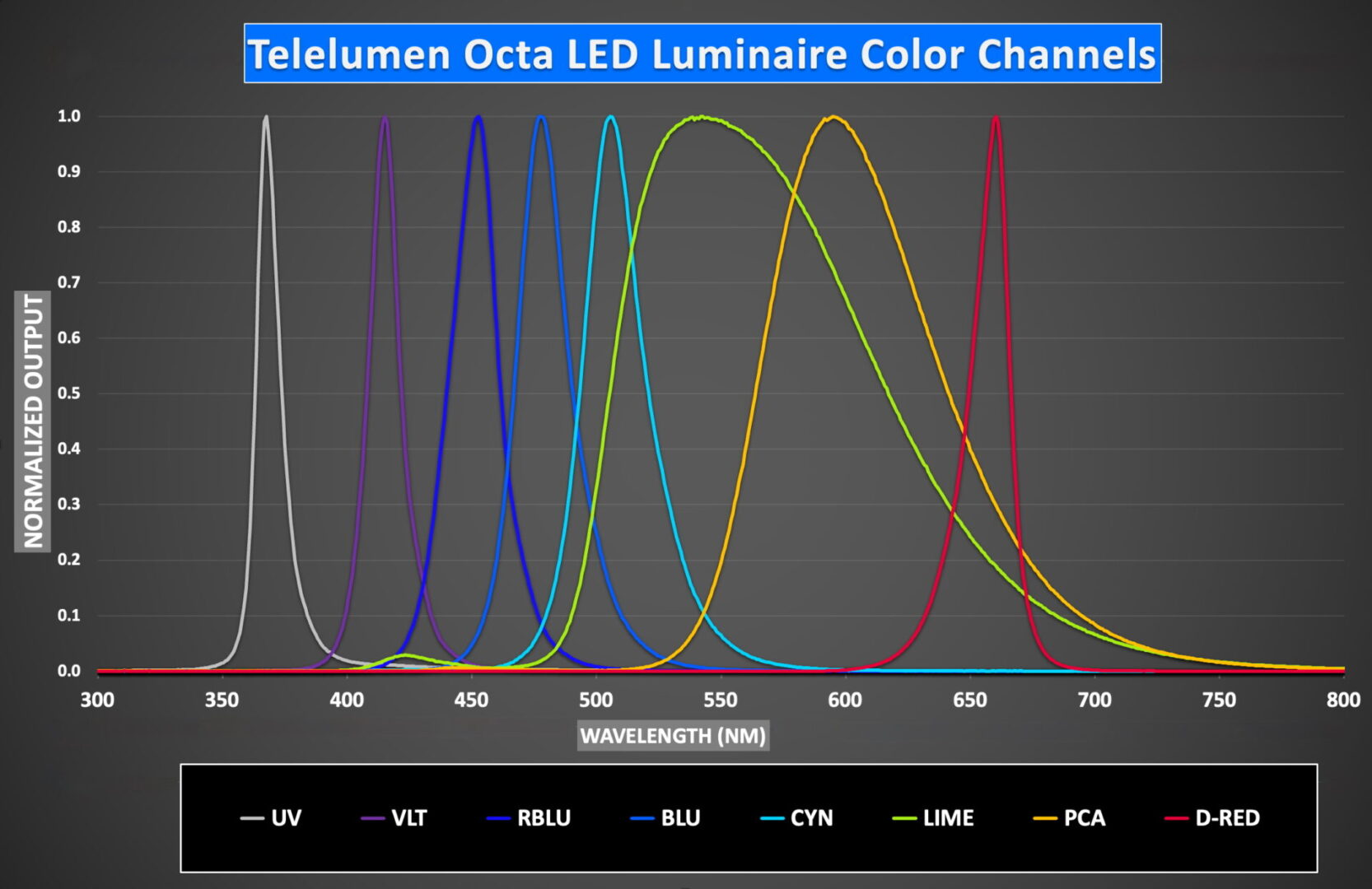
We at Telelumen could not agree more. For example, on the left is the normalized graph of the 8 LED channels of the Telelumen Octa Light Player, that are used to create custom spectral power distributions. The Octa offers full‐spectrum, dynamic lighting of 2,000 lumens across the entire color temperature range of 1500K to 20000K with high color rendering. In addition to standard white light tuning, Octa spectral light output can cover a majority of the CIE color space and is capable of producing CIE standards such as D50, D65.
Current News - Telelumen and GTI Technology Demonstration
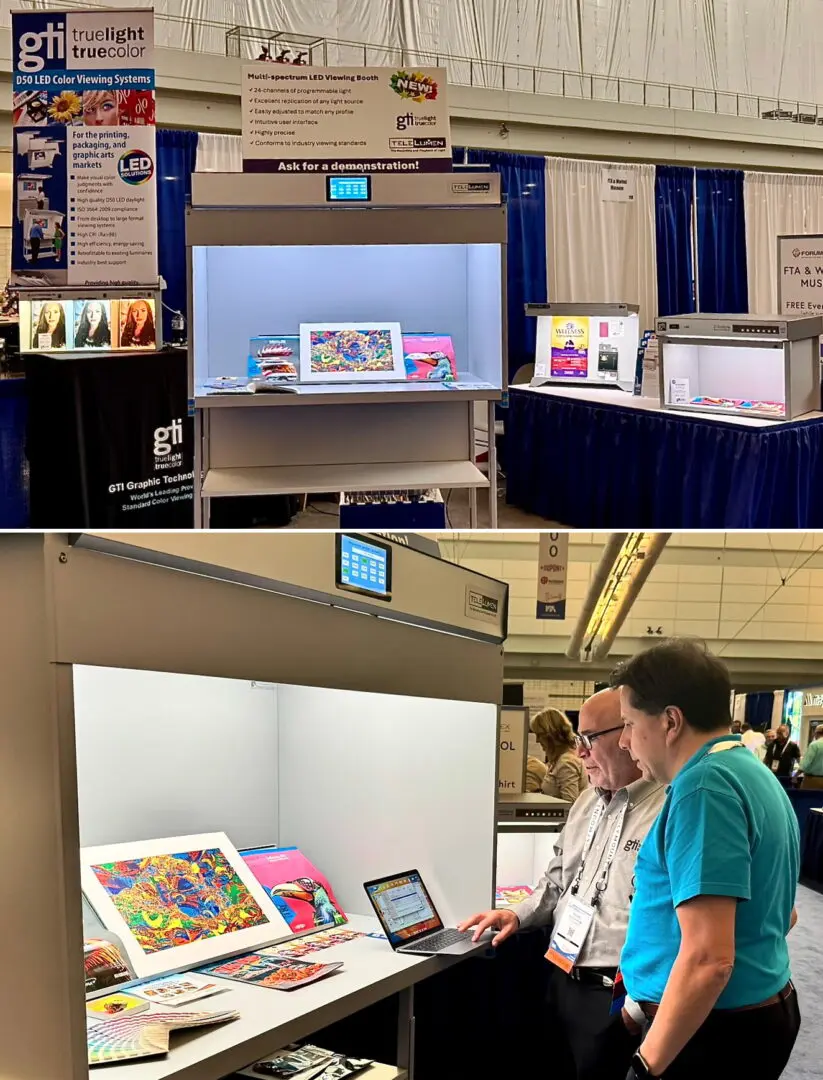
Since 2007 Telelumen has been a world leader in programmable full spectrum LED lighting. Since 1975 GTI Graphic Technology, Inc. has been a leading manufacturer of viewing booths for the visual appraisal of critical color. During the InfoFlex trade show in Pittsburgh, PA from May 5th to 6th, 2025, the two companies presented a technology demonstration of a new programable full spectrum LED viewing solution.
The demonstration viewing booth featured two Telelumen Dittosizer luminaires mounted on a GTI CMB-3052 color matching booth. The viewing area is 52” wide by 30” deep. The booth has the capability to output 10,000 lumens across 1,500K to 50,000K CCT spectrum, reproduce standard CIE illuminants such as D50 and D65, replicate any light source – LED, tungsten, fluorescent etc. and to be easily tuned to a specific custom target light spectrum profiles by using the built in touch screen. There are 12 industry spectrums pre-programmed and directly accessible through the touch screen. An optional physical separator can be inserted between the two luminaires for side-by-side viewing of similar objects under different light sources.
This new programable viewing system can eliminate the need for different lamp sets. With this one booth a user can easily view ISO 3664 and ASTM D1729 viewing conditions satisfying the need of the graphic arts and industrial color markets. At the same time end-use and retail lighting conditions can easily be replicated. This programmable and flexible color evaluation system will easily adjust to meet any lighting requirement enabling material testing to be more precise due to exact replication of all relevant lighting conditions.
The viewing booth is based on the Telelumen Dittosizer, a cutting-edge, fully programmable spectrum LED luminaire that uniquely integrates 24 independently controlled color channels, spanning from UVA to NIR. It delivers exceptional light output, exceeding 5,000 lumens, and is paired with advanced software capable of synthesizing any spectral power distribution. Telelumen’s software sets a new standard in flexibility, enabling users to precisely configure and resolve all 24 color channels to match any desired output spectrum. The Dittosizer can be adapted to fit on any GTI ColorMatcher viewing booth.
Current News - Society for Light Rhythms & Circadian Health
Telelumen is a proud sponsor of the Society for Light, Rhythms, and Circadian Health 36th Annual Meeting, taking place in Boston, June 13-16, 2025.
The Society for Light, Rhythms, and Circadian Health (SLRCH) is an international scientific non-profit organization devoted to promoting research and knowledge about the effects of light on the organism and humans.
Founded in 1988 as the Society for Light Treatment and Biological Rhythms, the society has brought together leading scientific experts, clinicians, and interested participants from different professional and multi-disciplinary backgrounds for discussion and exchange on the science and practical application of chronotherapy in medicine.
Steve Paolini, the CEO of Telelumen, will be giving a talk with the title: "Exploring the Complex Dynamics and Human Consumption of High CCT Daylight"
Brief Abstract:
Through the work of Telelumen, it has been revealed that the CCTs of natural daylight frequently exceed those typically observed in electric lighting products and clinical studies. This presentation will examine the surprising variability and high CCT content inherent in daylight and explore its often-underappreciated aesthetic appeal to humans. In doing so, it will propose potential avenues for future research aimed at refining our understanding of daylight's complexities and its broader implications for lighting design and human health.
Current News - Telelumen and Image-Engineering
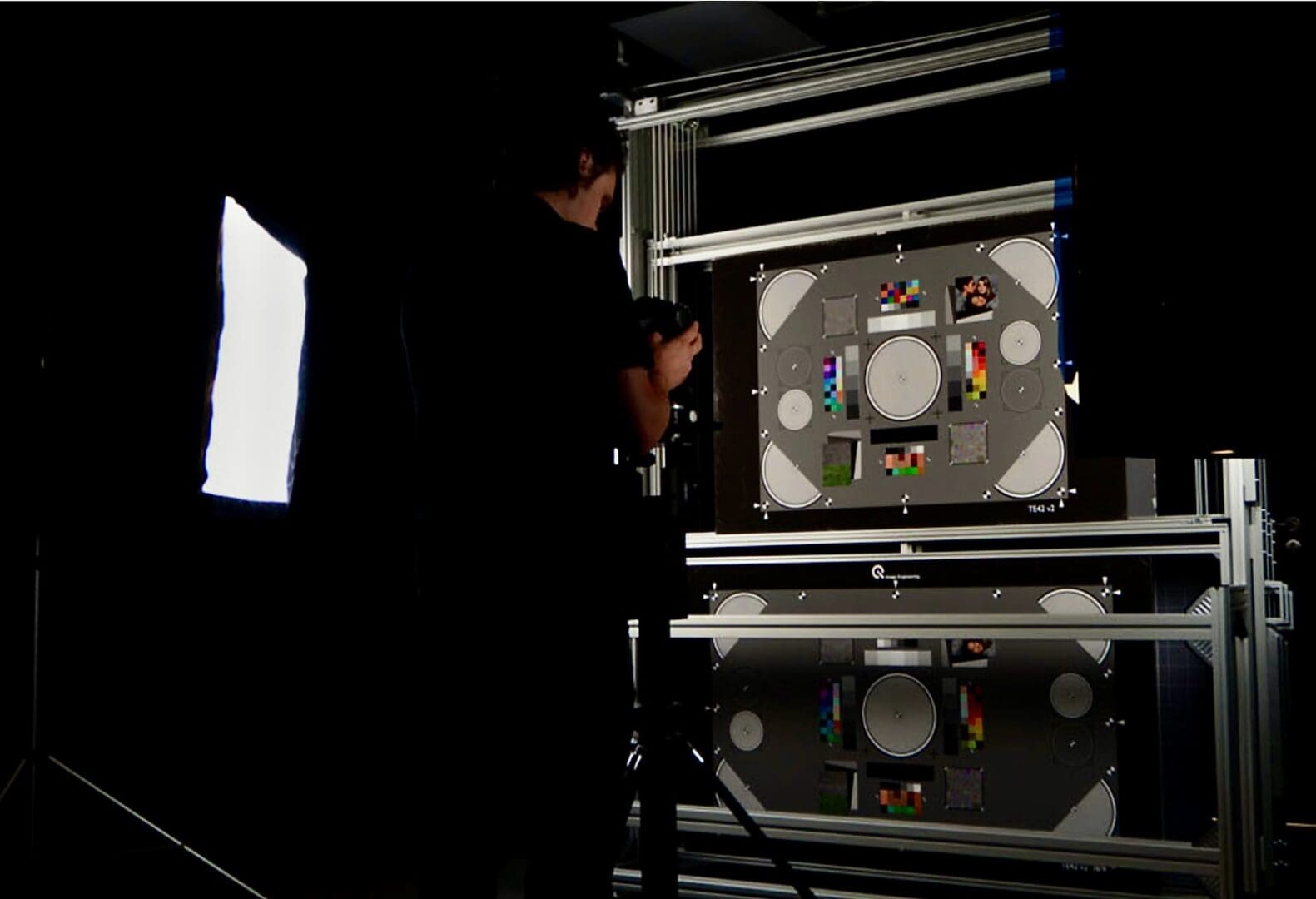
Telelumen has recently partnered with Image-Engineering to expand lighting solutions for companies needing accurate light spectrum illumination in their testing of products. Image-Engineering is a German company that has over the past 20 years led the development of the next generation of modular, automated, image quality testing technology that companies worldwide are utilizing to improve the performance of their cameras.
Telelumen software programable spectrum LED luminaires are dynamic multi-channel light synthesizers that can be installed in the ceiling and replace conventional lights. Their large area illumination capabilities are ideal for critical illumination control test environments, such as hospitals, human vision factor research, critical color evaluation environments (light booths) and test labs for cameras and displays.
Current News - IXR Platform Using Telelumen Luminaires
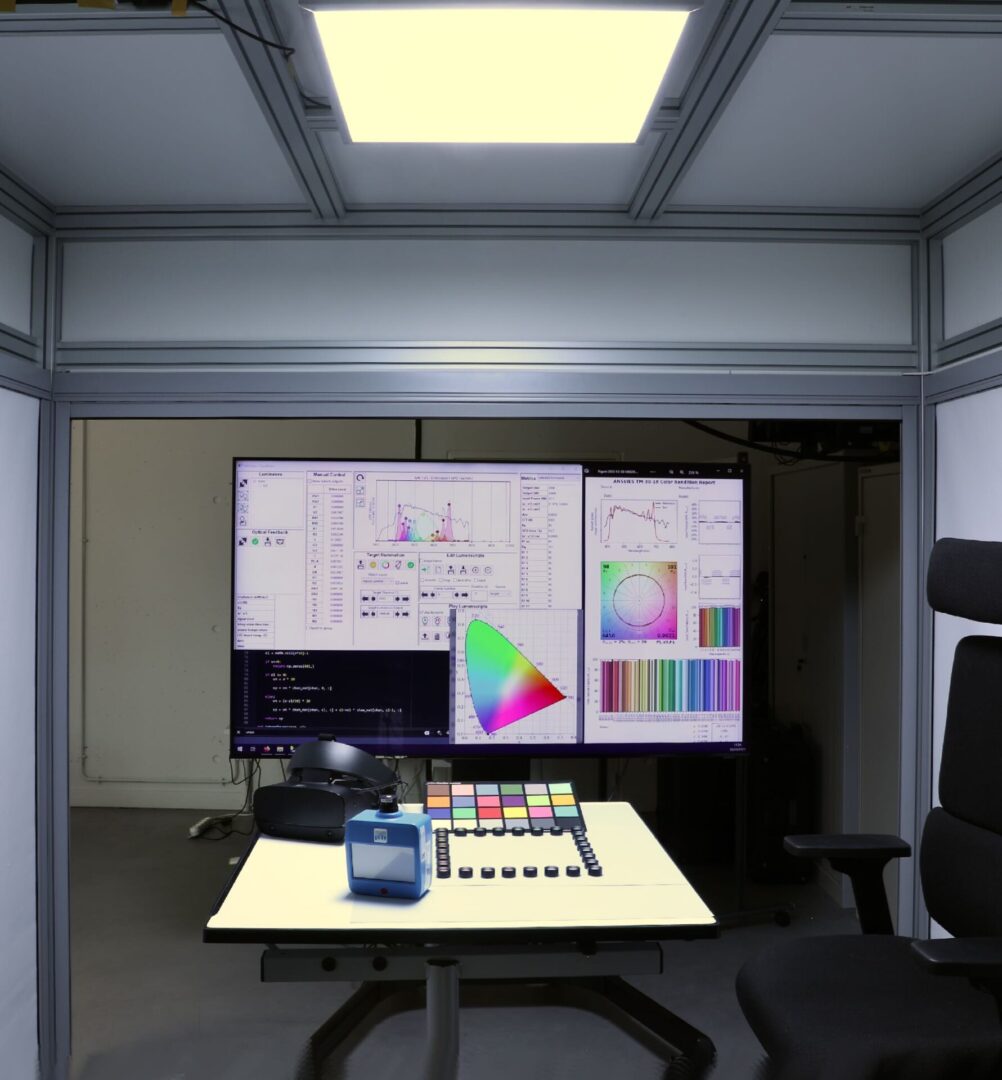
The worldwide aging population is leading to an increase in the number of people with vision impairments. The IXR Platform, an imaging and extended reality program of University Jean Monnet, Saint-Étienne, France, is currently doing research that focuses on studying the role of lighting in providing visual assistance to low vision people.
The light laboratory uses the Telelumen Dittosizer Light Player, a 24 channel programable spectrum LED luminaire, which allows the researchers to generate a very wide range of tailored light spectrum conditions. These lighting conditions are necessary for carrying out psychophysical experiments that investigate how lighting properties affect the visual performance of visually impaired people.